
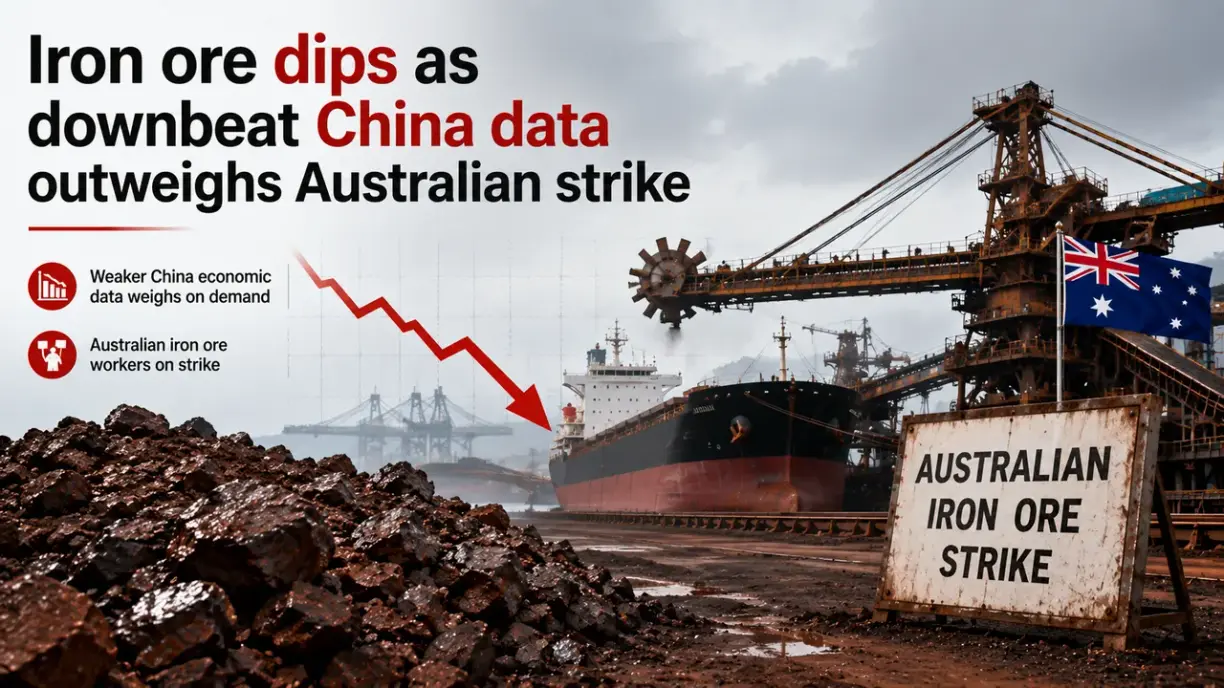
Iron ore prices eased on Monday, as downbeat factory-gate data in top consumer China fueled worry over demand prospects for the key steelmaking ingredient, although a strike at a major export hub in Australia curbed some of the decline.
The most-traded iron ore contract on China’s Dalian Commodity Exchange (DCE) DCIOcv1closed daytime trade down 0.35% at 713.5 yuan ($105.79) a metric ton.
The benchmark September iron ore SZZFU6 on the Singapore Exchange was 0.26% lower at $94.75 a ton, as of 0820 GMT, staying well below a key psychological level of $100 for 15 trading sessions.
China’s producer price inflation eased more than expected in July to its weakest in three months, while consumer inflation also cooled, as global energy prices retreated despite the U.S.-Israel war against Iran.
“A core driving force currently is steel demand. Domestic steel consumption in the manufacturing sector may shrink more than expected,” analysts at Galaxy Futures said in a note.
Torrential rain and storms in Typhoon Dolphin’s wake have swept through several provinces in China’s east, hindering outdoor activities and steel consumption.
But prices loses were limited as more workers joined a strike at BHP’s Port Hedland operations in Western Australia on Sunday, in the first major industrial action at the iron ore export hub in a quarter-century.
The hub accounted for 75% of iron-ore exports from the Pilbara region of Western Australia in the year to June.
Investors and traders were watching closely whether both parties could reach an agreement soon, or if an escalation later would hit supply.
Coking coal DJMcv1 and coke DCJcv1, other steelmaking ingredients, climbed 1.43% and 0.11%, respectively.
Steel benchmarks on the Shanghai Futures Exchange were mostly weaker. Rebar SRBcv1 eased 0.43%, hot-rolled coil SHHCcv1 nudged down 0.12%, wire rod SWRcv1 dipped 0.67% while stainless steel SHSScv1 added 0.31%.
($1 = 6.7443 Chinese yuan)
(Reporting by Amy Lv and Lewis Jackson; Editing by Rashmi Aich)
