
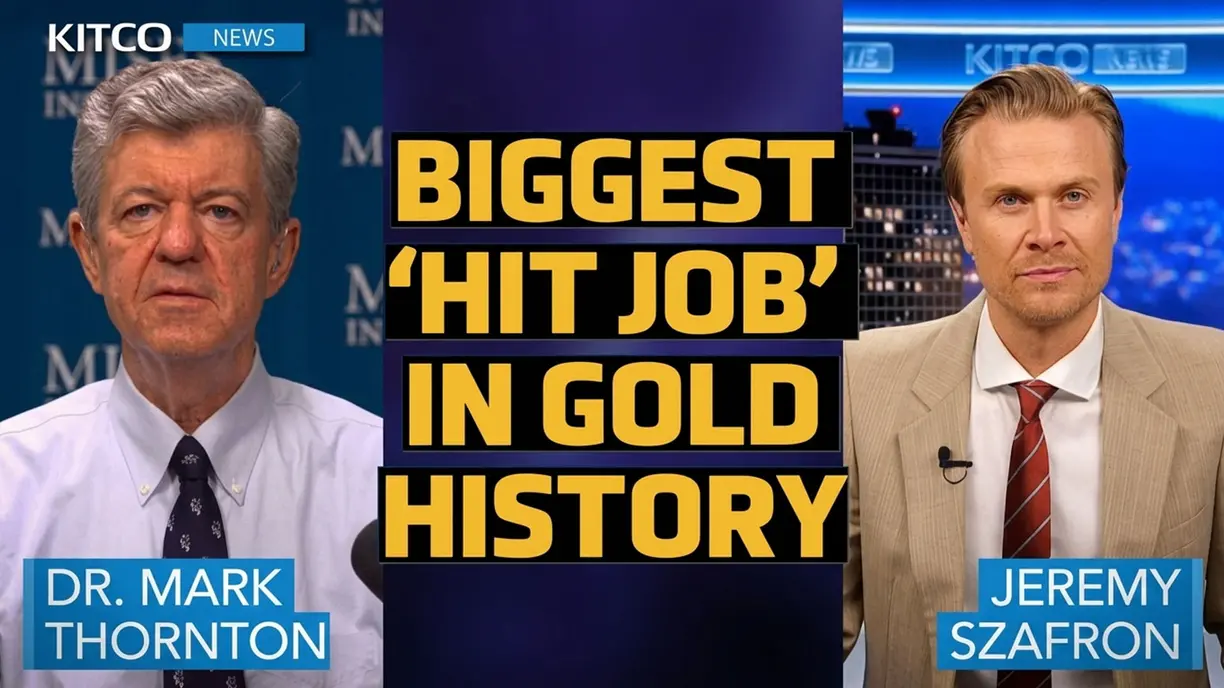
(Kitco News) - A stark divide between record corporate profits and plummeting consumer sentiment is not an economic paradox, but the predictable outcome of decades of monetary expansion, according to Austrian School economist Dr. Mark Thornton.
Speaking on Kitco News, the senior fellow at the Ludwig von Mises Institute detailed how artificially low interest rates and expansive monetary policy have driven a wedge between asset holders and the working class.
A historic, credit-fueled market peak
While mainstream analysts point to robust corporate earnings as a sign of broad economic health, Thornton views current market valuations as a historic warning sign fueled by cheap credit.
"The market is currently way overvalued in terms of historical norms," Thornton said. "The Buffett indicator is two and a half standard deviations above the historical long-term average." Furthermore, "the Case-Shiller measure of valuation of the S&P 500 is at its second highest level above normal valuations in history." Looking back 150 years, there has been "only one time when the Case measure of valuation was any higher in relative terms," he noted.
This credit-driven expansion disproportionately benefits large corporations, the banking system, and the government, leaving average consumers to bear the brunt of inflation—an economic phenomenon known as the Cantillon effect.
"The new money goes into the economy in general, but it goes into the hands first of a certain group of people," Thornton explained. "And so those groups are going to be advantaged because they're getting fresh money at current prices." As this money circulates, "what is showing up on the kitchen table is higher prices.”
The data reflects this squeeze: According to the University of Michigan, consumer sentiment plunged to a record low of 44.8 in May, with 57% of consumers explicitly citing high prices as a strain on their personal finances.
The Fed, Kevin Warsh, and the metals ‘hit job’
Addressing the Federal Reserve and the nomination of Kevin Warsh as its new chair, Thornton offered a sharp critique of the central bank's motives. The sudden drop in gold and silver prices immediately following the nomination news was not random, he argued.
"Kevin Warsh, of course, is going to go down in history as the biggest hit job on the market for precious metals," Thornton said. He suggested major financial institutions likely had advance notice of the supposedly surprise nomination of the hawkish candidate.
"The bullion banks and the big New York City banks would all have been consulted, would all have been informed of President Trump's decision prior to the market knowing about it," he stated. "The timing of all of that activity and the slam down that occurred... I don't think is coincidental."
Despite market speculation that a hawkish Fed chair might pursue a Volcker-style rate shock, Thornton argued such a move is mathematically impossible.
"Our national debt is over 120% of gross domestic product, which according to historians... once you get over 100, it's unsustainable and unrecoverable," he warned. "The idea of raising rates at this time and raising the cost of financing government significantly, like doubling the rates, would kill the economy".

The Middle East conflict and structural inflation
Compounding these monetary issues is the ongoing war in the Middle East, which has effectively closed the Strait of Hormuz and pushed U.S. gasoline prices above $4.50 a gallon. Thornton warned this represents a structural blow to global supply chains, impacting everything from fertilizer to the cost of mining base metals.
"If the war were to stop today, the destruction would hopefully stop," Thornton said. "But there's been a lot of destruction of the productive capacity of the Persian Gulf area, and that's not going to recover for years".
This energy shock is accelerating a broader commodity supercycle. "You look at the CRB index of commodity prices, it's zoomed up during this process and is now at a historic high," he noted.
The push for physical silver and a bottom-up solution
As geopolitical and monetary pressures mount, Thornton sees the public increasingly turning toward hard assets to insulate their savings. Reacting to recent federal legislation like the SILVER Act - aimed at decentralizing precious metals depositories across the U.S. away from the New York region - Thornton views it as a natural response to the fragility of the futures markets.
States like Texas are already setting up depositories and moving to eliminate capital gains taxes on gold and silver. The ultimate solution, according to Thornton, requires completely removing taxes on precious metals savings to protect the working class from currency debasement.
"Everything good in this world comes from the bottom up," Thornton concluded. "Nothing good comes from things that are coming from the top down".