
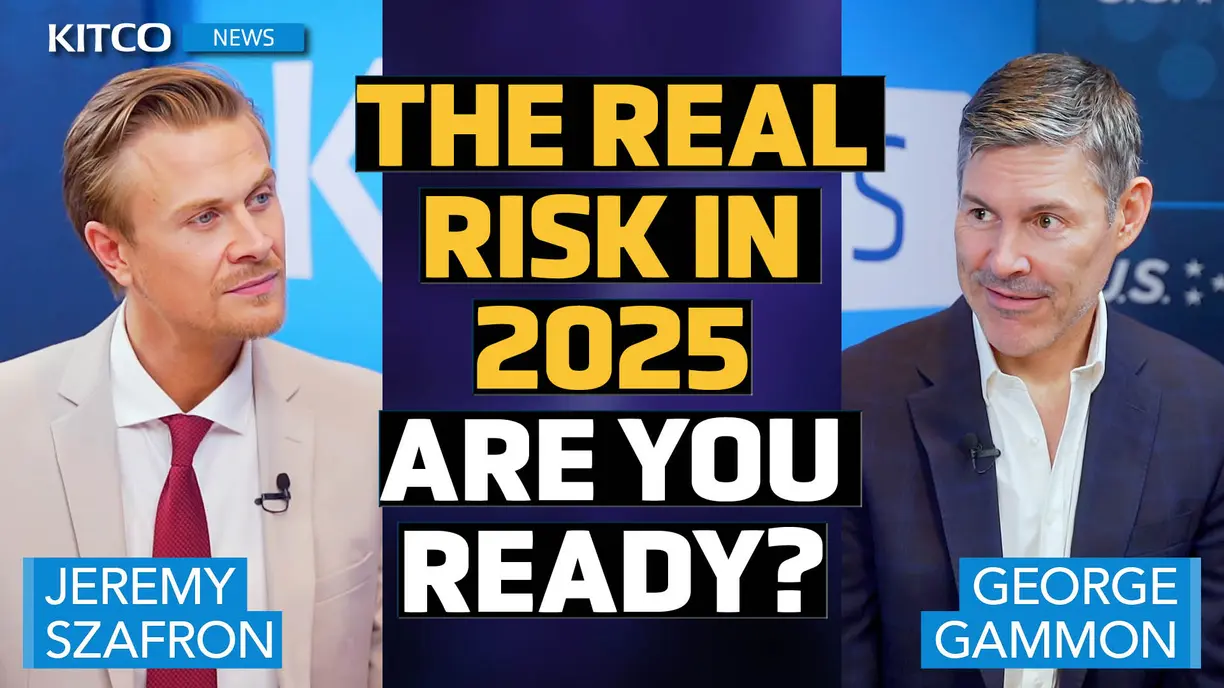
(Kitco News) - The market is misreading current economic signals, says renowned investor and macroeconomic expert George Gammon.
In a recent interview at the New Orleans Investment Conference, Gammon contradicted prevailing market sentiment by arguing that disinflation, not inflation, is the more likely outcome in the near future.
"The markets are not pricing disinflation or deflation for next year," Gammon told Kitco News anchor Jeremy Szafron. "They're pricing in the opposite. If you go back to the 1970s, when you got that big unemployment spike that we typically see in a recession or hard landing, the result was disinflationary."
Gammon pointed to historical parallels, emphasizing that while a resurgence of inflation is possible, disinflation is a more probable outcome. Watch the video above for insights.
"If you believe that the probability is high that we have a recession and the yield curve in the cycle does play out the same over the near term, your base case needs to be disinflation. The market is predicting the complete opposite," he said. "The end game, if you just fast forward a year or two, is rarely a re-acceleration of consumer prices. It's usually disinflation. That's followed by an acceleration of inflation due to the response mechanism from the central planners."
Gammon warned that the real economic crash usually comes after the Federal Reserve starts to cut rates.
"When you look at the yield curve, the crash rarely occurs when the curve is inverted. It occurs after the Fed starts dropping rates, making the curve steepen out and un-invert. That's when the stuff usually hits the fan," he said.
In terms of timing the recession, Gammon pointed to look at asset bubbles built up in the U.S. economy.
"The entire U.S. economy is built on asset bubbles,” he said. “Those bubbles may be able to continue, but they can't continue indefinitely into the future. So then, what is the pin that will prick that bubble to where it'll impact the aggregate demand? That's when you see a recession. It doesn't mean you have an absolute crash, like the Great Financial Crisis, but you see a balance sheet recession that may be very similar to what we saw in 2001."
Gammon dismissed concerns about a looming debt crisis, asserting that the real issue lies in excessive government spending. He explained that the demand for U.S. Treasuries, particularly from foreign banks seeking to capitalize on interest rate differentials, effectively provides the government with an "unlimited credit card." Watch the video above for insights.
This, in turn, allows for unchecked spending, which Gammon said distorts the economy and hinders the efficient allocation of resources.
Instead of focusing on debt reduction, Gammon advocated for a reduction in government regulations and bureaucracy. He believes this would "free up the marketplace" and unleash entrepreneurial energy, leading to increased production of goods and services and ultimately, enhanced national wealth.
Regarding investment strategy, Gammon urged investors to prioritize risk management and focus on identifying assets with favorable asymmetry — those offering greater potential upside than downside.
He highlighted gold, silver, miners, and uranium as sectors presenting such opportunities, though he cautioned against attempting to time the market. Watch the video above for insights.
While acknowledging the possibility of short-term volatility in commodity prices, Gammon pointed to a commodity supercycle, suggesting a long-term upward trend. Watch the video above for insights.
This video is brought to you by Uranium Energy Corp and U.S. GoldMining Inc.
