

The U.S. economy delivered a mixed picture this week, with employment data exceeding forecasts even as broader indicators pointed to a decelerating growth trajectory. The divergence highlights the complexity facing policymakers as they navigate an economy showing pockets of strength alongside signs of cooling momentum.
After another significant delay in the release of the nonfarm payrolls report, the Labor Department said that 64,000 jobs were created in November. Employment gains beat expectations, as consensus forecasts had called for job growth of 51,000.
Although the data show U.S. employment growth rising more than expected, economists note that the report also points to a clear slowing trend in the labor market. The unemployment rate rose to 4.6%, up from September's reading of 4.5%. Economists had expected the unemployment rate to remain unchanged.
No employment data were released for October due to the 43-day government shutdown.
The headline employment data, while positive, came with significant caveats buried in the revisions. August's employment data were revised to show a contraction of 26,000 jobs, compared to the previous estimate of a 4,000-job decline. At the same time, September's employment numbers were revised down to 108,000 from the initial estimate of 119,000.
In further disappointing news, the report also noted that wage growth was weaker than expected. Average hourly earnings rose 0.1% last month to $36.86, compared to a 0.2% increase in September. Economists had expected wages to rise by 0.3%, according to consensus forecasts.
The deceleration in wage growth adds another layer of complexity to the economic outlook, potentially signaling reduced consumer spending power even as employment levels hold relatively steady.
Adding to concerns about economic momentum, S&P Global reported on Tuesday that its flash Purchasing Managers Index (PMI) Composite Output Index fell to 53 after posting a 54.2 in November. Economists expected a shallower decline to 53.2.
The decline was primarily driven by a weakening in services. The Service Sector PMI fell to 52.9, down from November's reading of 54.1. According to consensus estimates, economists were looking for a reading of 53.
At the same time, the Manufacturing PMI fell slightly to 51.8, down from November's reading of 52.2. The data was also below expectations as economists expected a decline to 52.
While both sectors remain in expansion territory—any reading above 50 indicates growth—the downward trajectory suggests momentum is fading across the economy. The services sector, which accounts for the bulk of U.S. economic activity, showed weakness, raising questions about the sustainability of current growth rates.
Precious Metals Diverge in Market Response
The precious metals complex showed divergent reactions to the mixed economic data, with platinum significantly outperforming while silver slipped from recent highs.
Platinum futures surged 3.22%, gaining $58.40 to trade at $1,874.30 per ounce. The industrial metal has broken out from its recent consolidation pattern, rallying sharply from the $1,500-$1,700 range that dominated trading through much of the fall. The move higher reflects both safe-haven demand and growing optimism about industrial demand, particularly from the automotive and chemical sectors.
Silver futures declined 0.52%, shedding $0.335 to trade at $63.795 per ounce. Despite Monday's modest pullback, silver remains near historically elevated levels after a remarkable rally from around $40 per ounce in August to a recent peak near $66. The metal's consolidation just below all-time highs suggest traders are evaluating whether industrial demand and monetary concerns can sustain prices at these levels.
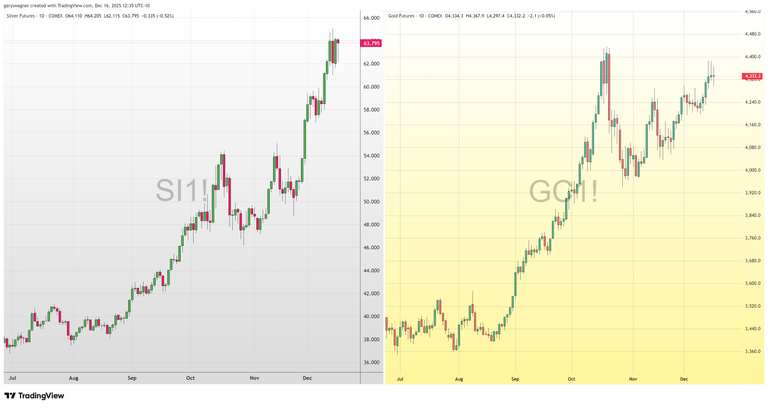
Gold showed the most measured response. Gold futures traded at $4,331.20 per ounce as of Monday afternoon, up just $0.90 or 0.02% on the day. The precious metal has experienced significant price swings over the past two weeks, reaching a high of $4,387.80 before pulling back to current levels, with support holding above $4,197.80.
The relatively muted gold response reflected investor uncertainty about the broader economic implications of the employment report, with stronger-than-expected job creation offset by rising unemployment and weak wage growth. Gold's elevated trading range—maintaining levels above $4,300—suggests investors continue to view the metal as a hedge against economic uncertainty, even as they digest conflicting data about the strength of the U.S. economy.
Platinum's stronger performance, combined with silver's resilience near multi-year highs, may indicate that investors are positioning for sustained industrial demand despite concerns about broader economic growth, or that supply constraints are beginning to tighten across the metals complex.
For those that would like more information about our services click here.
Wishing you as always good trading,
