
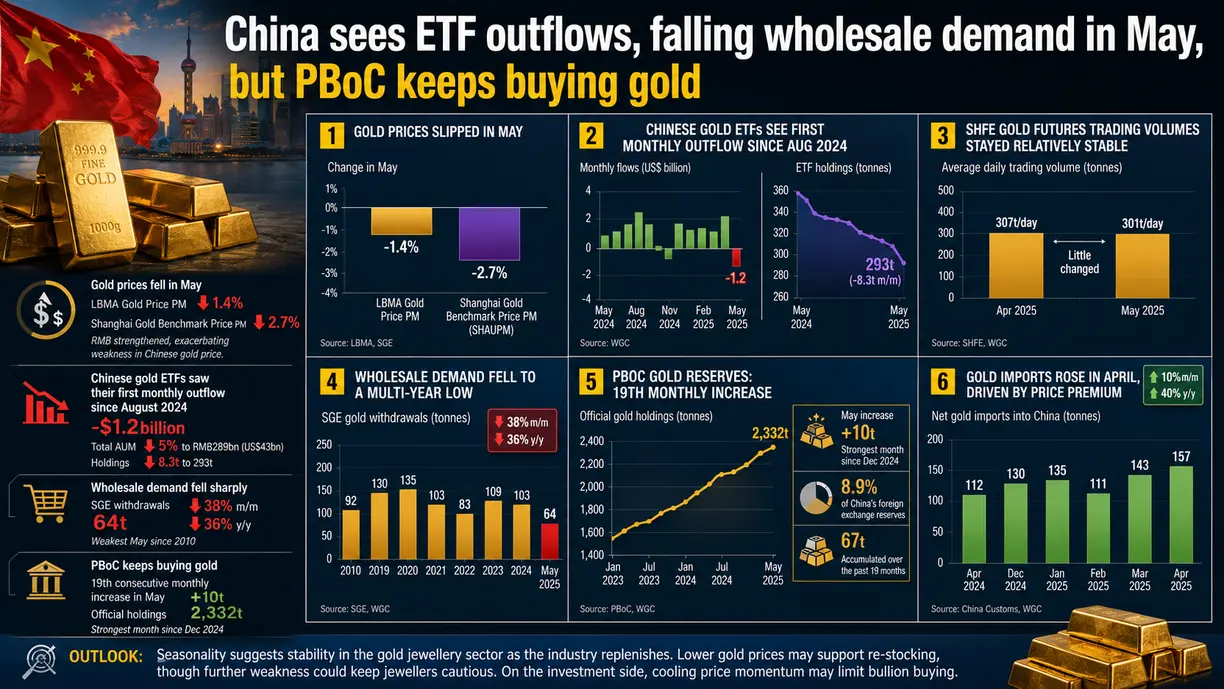
(Kitco News) – Gold prices slid lower in May as China saw the end of an eight-month streak of ETF inflows, all while wholesale demand fell sharply, but the country’s central bank continued to stock up on bullion, according to Ray Jia, research head for China at the World Gold Council (WGC).
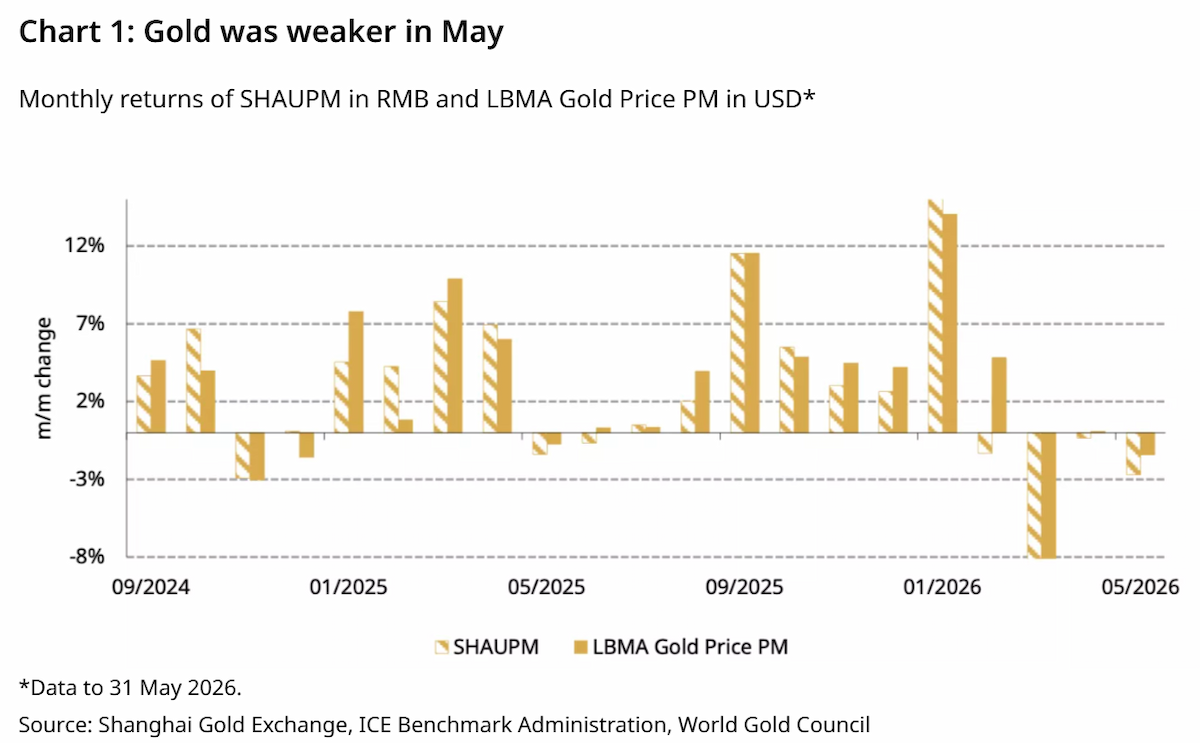
In the WGC’s latest China gold market update, Jia noted that international and domestic gold prices ended May with a modest decline.
“The LBMA Gold Price PM was down 1.4% and the Shanghai Gold Benchmark Price PM (SHAUPM) fell by 2.7% – as the RMB strengthened it exacerbated the weakness in the Chinese gold price,” he wrote. “Uncertainties in the Middle East and related inflationary concerns – which pushed yields and the dollar up – were key drivers of gold in the month.”
Meanwhile, Chinese gold ETFs saw their first monthly outflow since August 2025, losing $1.2 billion in May. “Combined with a lower gold price, total AUM declined by 5% to RMB289bn (US$43bn),” Jia said. “Chinese gold ETF holdings had dropped 8.3t to 293t by the end of the month,”
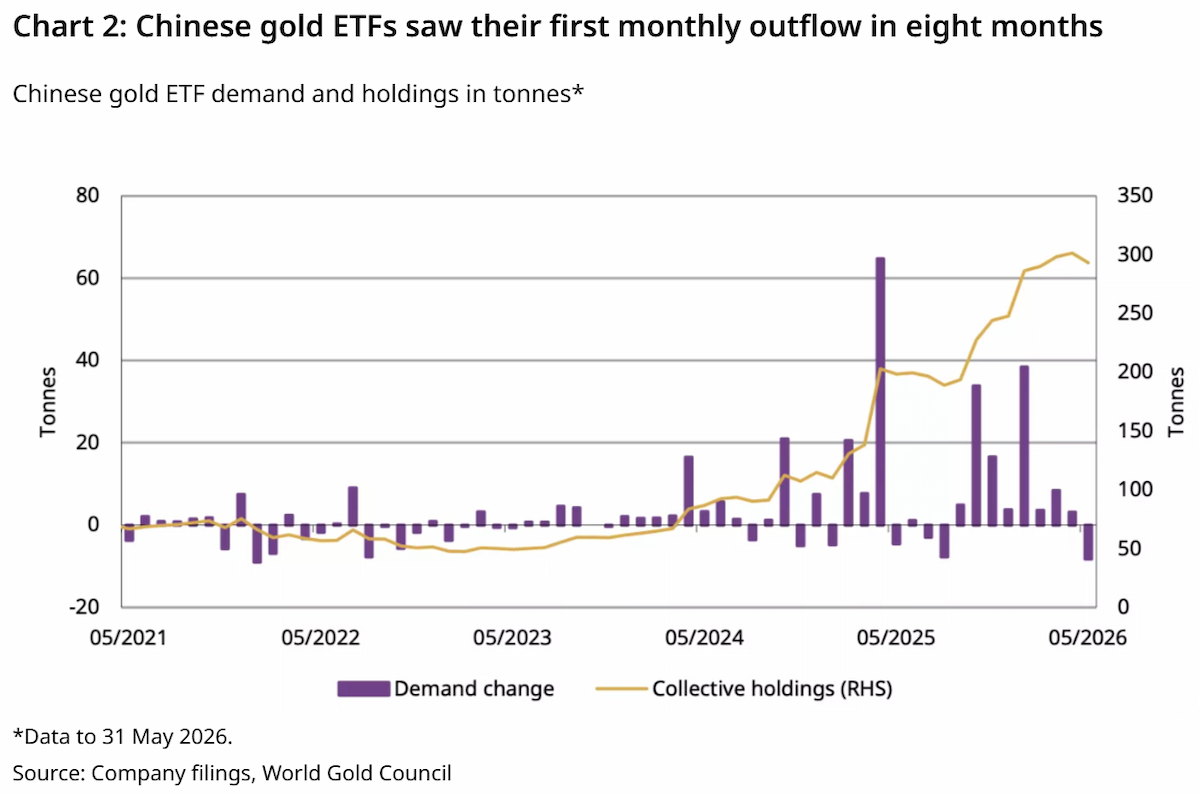
Jia said that sustained local equity market strength during the month pulled investors away from gold, while “the lack of a clear gold price trend prompted some to sell their gold ETF holdings.”
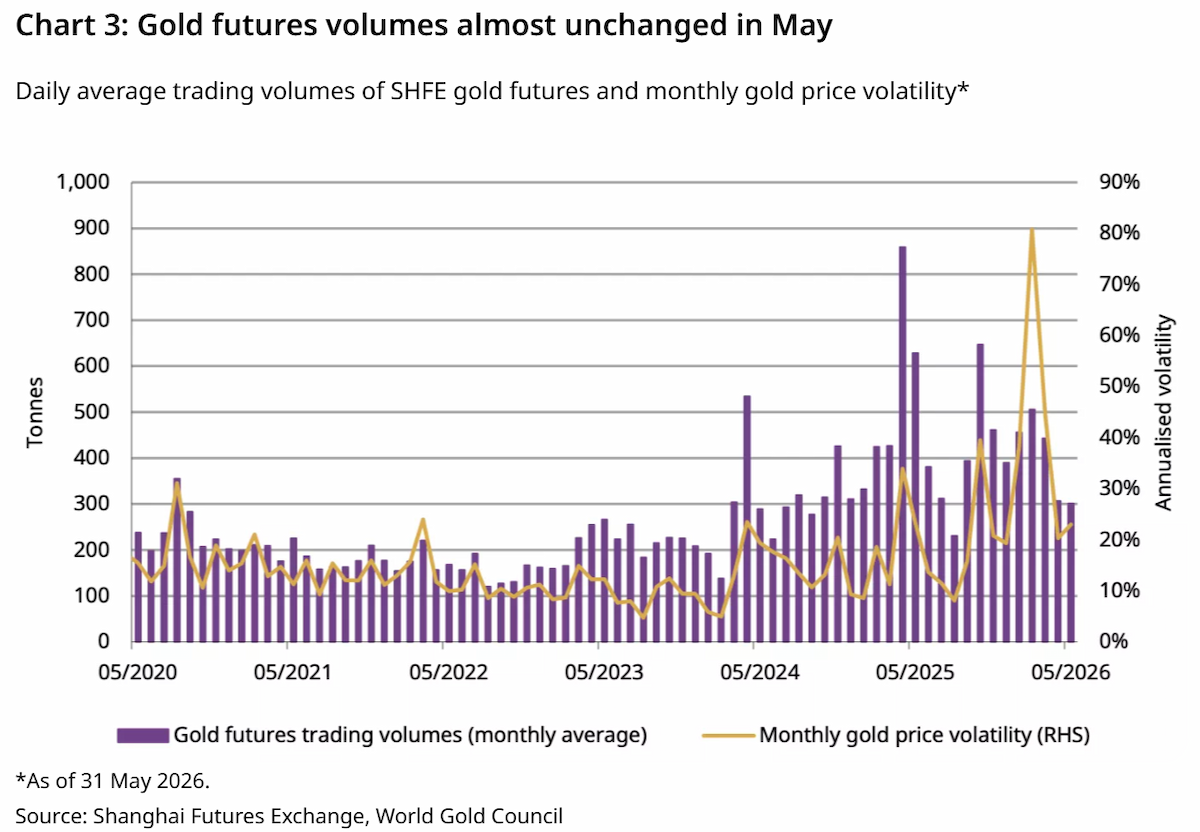
Gold futures trading volumes on the SHFE stayed relatively stable, averaging 301 tonnes per day in May. “This was little changed from April’s 307t/day as trading activities were constrained by the consolidating local gold price and elevated investor interest in the local equity market,” he said.
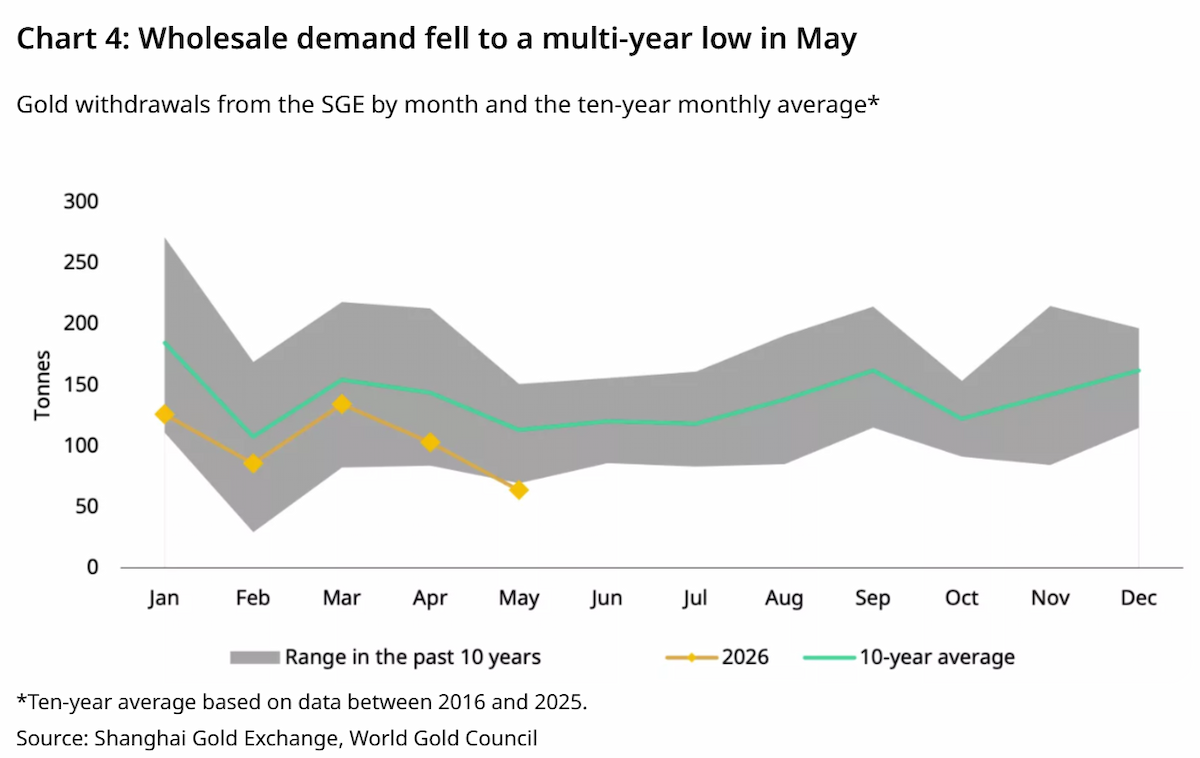
And on the wholesale side, demand continued to decline last month.
“Gold withdrawals from the SGE totalled 64t, 38% lower m/m,” Jia wrote. “On a y/y basis, withdrawals declined by 36%, making this the weakest May since 2010. The weakening gold price during the month, along with attention-grabbing equities, dented safe-haven demand for gold investment products. And persistent weakness in the gold jewellery sector amid affordability issues and additional tax burdens – despite mild upticks during May as the price stabilised – kept jewellers cautious in restocking.”
“Taken together, May’s wholesale demand took a hit, falling to a multi-year low.”
China’s central bank, on the other hand, took the opportunity to ramp up its gold buying last month.
“The PBoC announced its 19th consecutive monthly gold reserve increase in May, pushing official holdings 10t higher to 2,332t,” Jia noted. “This marks the strongest month of official sector gold purchases since December 2024.”
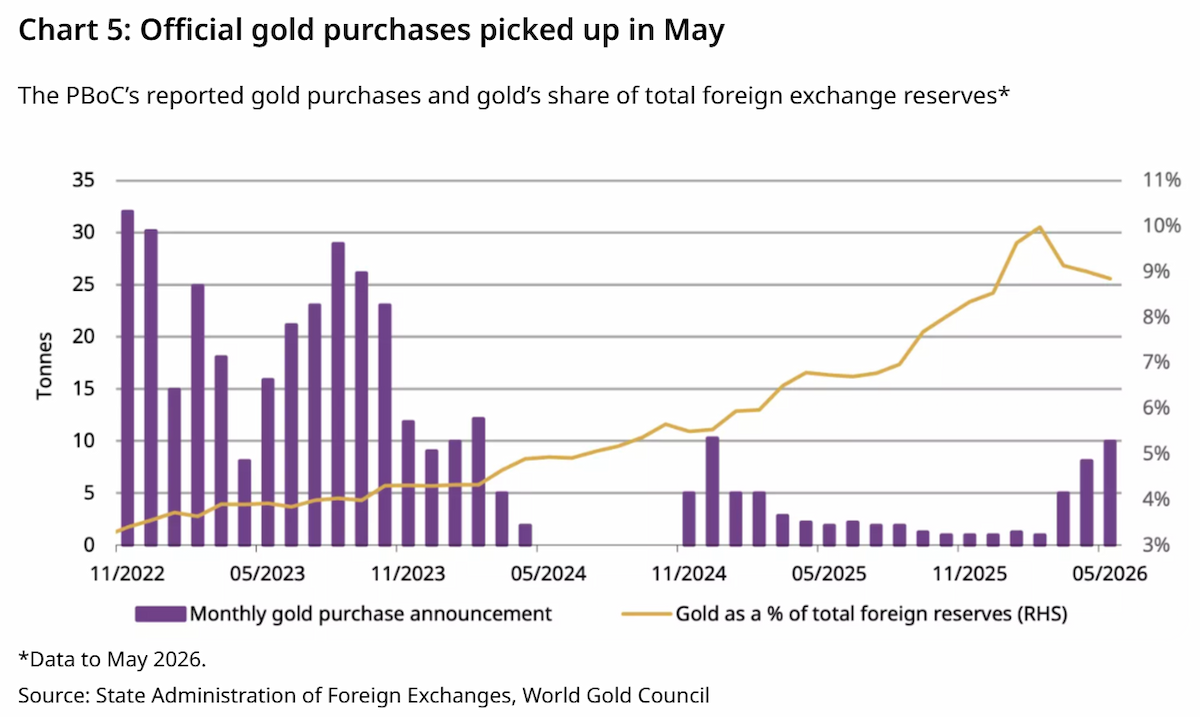
“Official gold holdings have risen by 25t y-t-d and now account for 8.9% of China’s foreign exchange reserves,” he added. “The country’s official sector has accumulated 67t of gold during the past 19 months.”
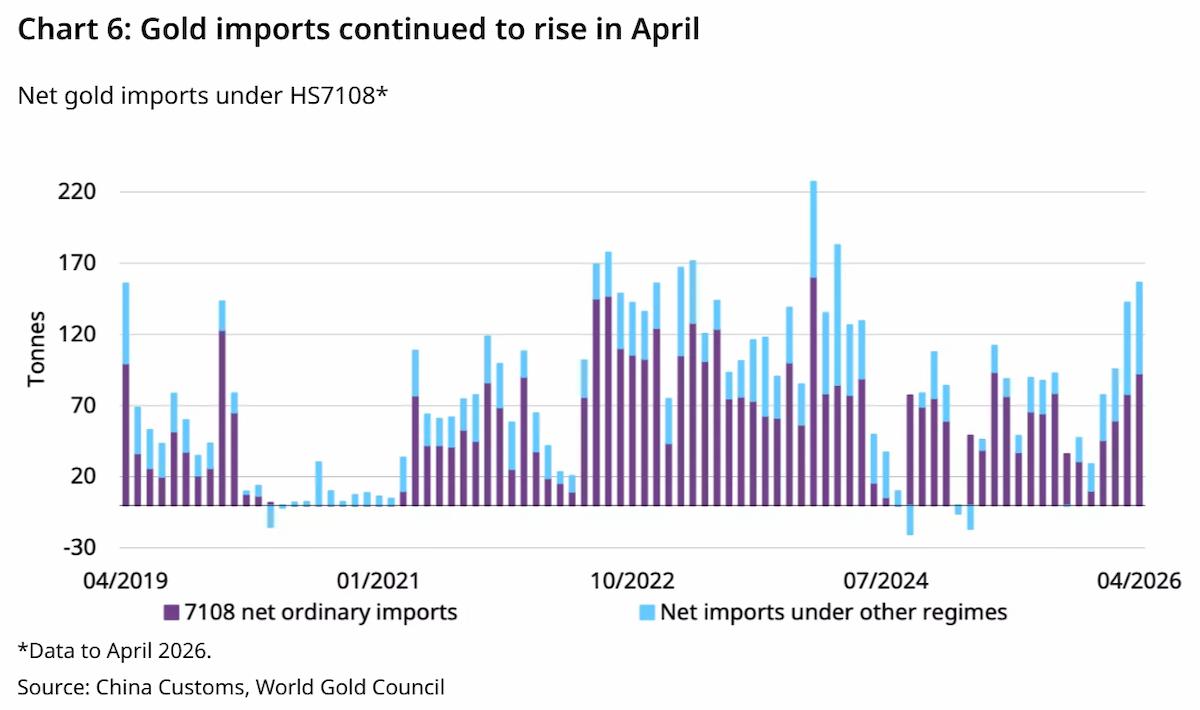
Imports also rose in April, driven by the domestic price premium.
“Net gold imports into China totalled 157t in April, according to the most recent data from China Customs, rising 10% m/m and 40% higher y/y and making this the strongest month since March 2024,” Jia said. “The positive local gold price spread remained a key factor in encouraging imports.
Looking ahead, Jia said that seasonality “suggests stability in the gold jewellery sector as the industry replenishes following weak buying in previous months.”
“The lower gold price may help boost these re-stocking activities, although jewellers may sit on the sidelines if the price weakness accelerates,” he added. “On the investment side, a cooling gold price momentum could further limit bullion buying.”
